BC Hydro / Strata EV Demand Response Pilot
How Variablegrid worked with BC Hydro to prove that multi-unit residential buildings (MURBs) and EV charging can deliver meaningful peak demand reduction.
“Variablegrid helped us achieve meaningful power reductions during demand response events.” — Alec Zaine, Program Manager, Demand Response (Commercial & Industrial), BC Hydro
The Client
BC Hydro is British Columbia’s primary electric utility, serving more than 5 million people across the province. As EV adoption accelerated across the Lower Mainland, BC Hydro needed to prove a thesis: that managed residential charging could become a dispatchable grid resource, not just a growing load.
They partnered with Variablegrid on a pilot project.
The Challenge
EV charging in multi-unit residential buildings (MURBs) stacks onto the grid at exactly the wrong time: weekday evenings between 5 p.m. and 9 p.m., when residential demand already peaks.
Before BC Hydro could scale a commercial demand response program for this segment, three questions had to be answered with real data:
- Can MURB charging be curtailed reliably during peak windows?
- Will strata residents actually participate when asked to shift a charging session?
- What does the per-driver kW reduction look like in practice, not in a model?
The Solution
Variablegrid has two capabilities no other partner can provide: controlling EV chargers at scale inside strata buildings, and delivering utility-grade, granular data on every event, every charger, every driver.
The result was a 200-site pilot that behaved like a single grid asset. BC Hydro scheduled events, Variablegrid dispatched them, and every charger reported back in 15-minute intervals, across two full peak seasons.
Program at a glance
- 200 sites in the initial pilot — mixed hardware managed as a single dispatchable resource
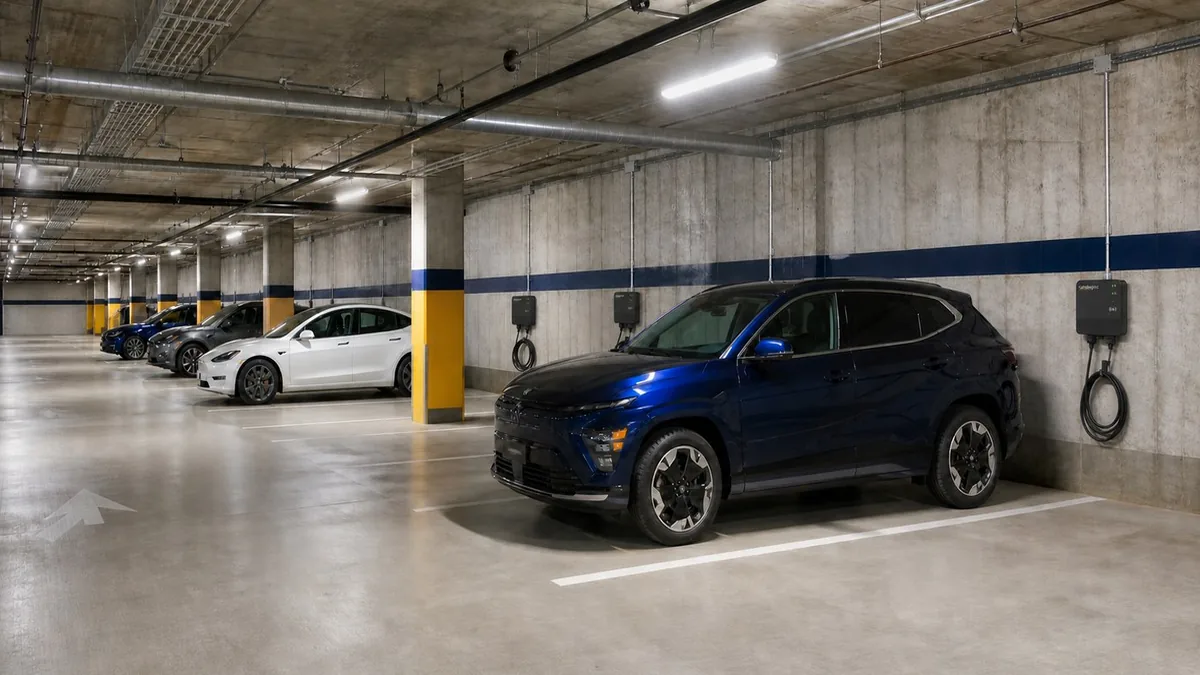
- 13 strata buildings across Vancouver, West Vancouver, North Vancouver, Burnaby, and New Westminster
- 23 demand response events — 10 summer (Jun 1 – Sep 30, 2025) and 13 winter (Nov 1, 2025 – Feb 28, 2026)
- 4 p.m. to 8 p.m. event window with 24 hours advance notice to residents
Execution That Delivered
Variablegrid ran the pilot end to end: driver onboarding, event dispatch, opt-out handling, curtailment, and utility reporting, across a mixed hardware fleet spanning VarianRS40, Grizzl-E Smart, EVoCharge, and more. That heterogeneity is the real world of strata charging, and Variablegrid’s platform presented it to BC Hydro as a single, dispatchable resource.
- 100% event delivery. All 23 events delivered on the BC Hydro schedule, from Friday June 13, 2025 through Friday February 20, 2026.
- On-contract reporting. 15-minute interval data, per charger, per event.
- Seasonal performance reports delivered to BC Hydro on October 2, 2025 and March 3, 2026, providing a clean, auditable data set for each peak season.
- Hundreds of strata residents onboarded with individual opt-in and opt-out controls and per-driver baseline profiles.
Results
- 200 sites in the initial pilot — mixed hardware managed as one dispatchable resource across 13 strata buildings
- 700 kW total program savings — aggregate peak demand reduction across two full peak seasons
- 15-minute data granularity — interval telemetry per charger, per event, per driver, submitted within one business day
Why It Matters
Every EV that plugs in at 6 p.m. is a potential grid liability — or, with the right orchestration layer, a peak-shaving asset. BC Hydro and Variablegrid proved the second case: on real strata buildings, on mixed hardware, with real residents, at utility-grade data standards. For any utility facing the residential electrification curve, this pilot is the playbook.
Variablegrid Adaptive Power Inc. builds the operating system for electrified buildings, enabling fast Level 2 EV charging in MURBs without costly electrical upgrades and turning distributed charging loads into dispatchable grid resources.